Listening at Limbo
Art Basel's Accra film, and the city around it
An Art Basel film follows an artist through Accra with a Ghanaian rapper as his guide, while the museum hosting him reads the city its own way.
A building on the University of Ghana campus was never finished. It has no doors, no windows and no permanent collection. Since 2024 it has been Limbo Museum. According to AD Middle East, a local farmer cultivated the site for years, growing corn, cassava and papaya.
That unfinished building is where Alvaro Barrington's exhibition 'Western Beef / Western Union' was announced to open on 29 October 2026, as part of Accra Cultural Week. It runs until 1 February 2027 and is curated by Diallo Simon-Ponte. Barrington was born in Venezuela, raised between Grenada and New York, and is now based in London. An announcement published by Gallery Thaddaeus Ropac calls the show his first solo presentation on the African continent, and says it closes a residency at Limbo.
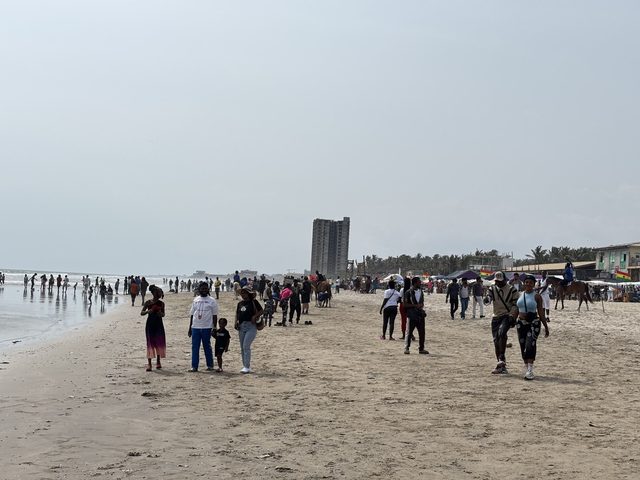
Art Basel's film 'As Seen By' follows him to Accra while he prepares it. The Ghanaian hip-hop artist Teshieboi is his guide, and Dominique Petit-Frère, Limbo's founder and director, interviews him. Art Basel says the film moves from a local weaving workshop to the coastline, kitchens and nightlife, and calls it a portrait of Accra "through the eyes of an artist discovering it." The film's credits name the crew behind the camera, among them Kumi Obuobisa, Daniel Attoh, Nii Phoobe and Ibrahim Yakubu.
Barrington describes his task as restraint. "How do I make sure I don't come here with a dominating energy, but with a listening energy?" he asks in the interview. He says he had been in Ghana only a few days: "It's just the beginning of the process of me listening, as opposed to coming here with a sense of what art people here need to see." He says he wants an installation "about being in a space that is asking you to listen."
He is also plain about where he stands. "I'm here, but I'm really making from an American perspective," he says, and calls himself "a global artist, even though I think of myself as an American artist as well." The Ghana he knew from his newsfeed, he says, reflected "a very small subset of people and a country filled with millions of people." One thing surprised him. "This was the first place I've come to where everybody I spoke to who lives here said, 'It's such a safe place.'"
Petit-Frère's view of the building begins with a number. "Twenty percent of Ghana's built environment is unfinished," she told AD Middle East. "Often when people see these spaces, they see it as a point of failure. But the minute we step into them, the perspective shifts." Limbo began in 2018 as an architectural practice and became a museum six years later.
Barrington arrives in a scene that already has its own institutions. The Art Newspaper reported in November 2024 that Accra Cultural Week is an initiative of Gallery 1957, which is based in Accra and London. The same report counted about two dozen other galleries in Ghana, a number it said had risen considerably in five years. One of them is Compound House, founded by Nuna Adisenu-Doe, who told the paper he is interested in experimental practices. A separate Art Basel story on Accra names Paul Ninson, a photographer, filmmaker and curator, as the founder of Dikan Gallery. That year, according to The Art Newspaper, El Anatsui, Ablade Glover, Serge Attukwei Clottey, Gideon Appah and Ibrahim Mahama all had solo shows at international venues. The paper also cautioned that more visitors had not yet clearly meant more sales or more local collectors.
Some things remain open. AD Middle East timed the exhibition to the 10th anniversary of Accra Art Week, while Art Basel places it in Accra Cultural Week. Neither says whether these are one event or two. The film does not say how long Barrington stayed beyond those first few days, and we have not seen the installation.
The film's title promises one man's Accra, and Barrington is careful to say it is only that. A visitor who names his own vantage point ("an American perspective") and calls his first days "the beginning of the process of me listening" makes no claim to speak for the city. In practice, that may leave room for the Ghanaians in the frame to carry more of the meaning than the title suggests.
Look at who does the guiding. As the guide, Teshieboi appears to set where the camera walks. Petit-Frère says people often see unfinished spaces as a point of failure. The scene The Art Newspaper describes, with Gallery 1957, Compound House and roughly two dozen galleries, suggests that the work of telling Accra to itself was already under way when this film was made. Read this way, the film is less a discovery than a visit hosted by people with their own account of the place.
The strongest counter-reading is that a major platform's outsider portrait still sets the international frame, whoever holds the map. That frame may be what collectors abroad remember, at a time when local buying had not yet grown. What would change our mind is hearing Teshieboi's own account of the route, and the view from the people named in those credits.
Barrington's word for the installation is listening. Limbo's word for its building is unfinished. Both seem to leave the ending to someone else.
“Often when people see these spaces, they see it as a point of failure. But the minute we step into them, the perspective shifts.”
- Accra As Seen By Alvaro Barrington (Art Basel)
- Alvaro Barrington: Western Beef ft. Western Union (Thaddaeus Ropac)
- The Limbo Engawa Pavilion in Ghana (AD Middle East)
- Accra Cultural Week shines a light on Ghana's burgeoning art scene (The Art Newspaper)
- How collaboration, community building and care transformed Accra's art world (Art Basel)