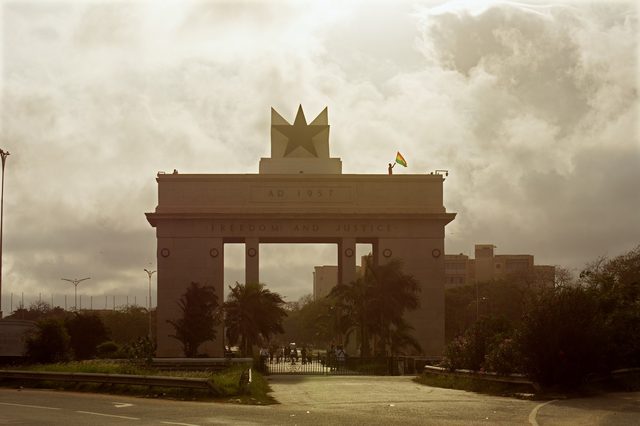
Two Hands, One Coast
Ghana, Nigeria and the price of being the gateway
Ghana sells itself to investors as Africa's open door. Nigeria's banks, onions and traders show what that door costs, and why the question of who sets the rules is still open.

On 23 September 2026, at the Nasdaq in New York, President Mahama gave American investors a number and asked them to look past it. "Do not look at Ghana's 34 million population only for what you can sell there," he said, on the sidelines of the 81st UN General Assembly. Graphic Online reported that he assured them the country's macroeconomic turnaround and political stability make it the ideal gateway to Africa. He also named the market behind the door: "The African Continental Free Trade Area is bringing together a continental market of more than 1.4 billion people, and this secretariat is headquartered in Accra."
A gateway is a promise about traffic, and traffic runs both ways. Nigerian banks hold Ghanaian accounts, Nigerian onions stock Ghanaian markets and Nigerian traders keep shops in Ghanaian towns. Each of those ties now has a figure attached, and a dispute.
Start with the money. Blueprint, a Nigerian outlet, reported that the foreign subsidiaries of Nigeria's four biggest banks, Access, Zenith, UBA and GTCO, made a combined pre-tax profit of N627.027 billion in 2023. That was up 329.61 per cent from N145.953 billion in 2022. Ghana carried much of that turnaround. Access Bank Ghana posted a pre-tax profit of N77.719 billion after a pre-tax loss of N22.294 billion the year before. Zenith Bank Ghana led Zenith's foreign subsidiaries with N75.206 billion, after a 2022 loss of N27.776 billion that Blueprint tied to a high impairment charge. A rebound measured against a loss is still a rebound; it is also a measure of how bad the loss was. Not every lender shared in it: UBA Ghana recorded a pre-tax loss in 2023, according to Blueprint's reading of UBA's audited statements. The figures are in naira, as Blueprint gave them.
A bank answers to a regulator. A shop answers to a capital threshold. The Ghana Investment Promotion Centre Act of 2013 sets a minimum of US$500,000 for wholly foreign-owned firms. For trading concerns, which must also employ at least twenty skilled Ghanaian workers, the minimum is US$1 million. Imani Africa reports that the Ghana Union of Traders Associations (GUTA) has sparred with the Nigerian Union of Traders Associations, Ghana (NUTAG) over how the Act's reserved-sector rules are enforced. GUTA's argument, as Imani sets it out, is that undercapitalised foreign resellers undercut local prices unfairly. Imani's own finding points elsewhere: "Despite its symbolic weight, the one-million-dollar clause was rarely cited in multilateral assessments as the principal hurdle to FDI."
That gap between symbol and statute has played out in shop doors. StarrFM, reproduced on GhanaWeb on 6 November 2023, reported that GUTA's Eastern Region closed more than 38 foreign-owned retail shops in Koforidua, most of them selling mobile phones. GUTA cited non-enforcement of the GIPC Act. Its Eastern Regional Vice Chairman, Mr Samuel Aikins, put the economy's troubles at the traders' feet: "Their activities are affecting the economy. Look at the soaring inflation, rapid depreciation of the Ghanaian Cedi, the collapse of the manufacturing sector." That is GUTA's claim, not an established finding.
Closures like that strain relations between two capitals, so governments have tried twice to settle the matter on paper. In 2021, at an Extraordinary ECOWAS Summit, Ghana and Nigeria signed a joint communique that exempted Nigerians from the US$1 million requirement. The exemption was aimed at a retail dispute GhanaWeb described as 25 years old, and Ghana's Speaker, Alban Bagbin, presented it to Nigeria's House of Representatives. GUTA strongly opposed it and threatened to resist any amendment to the regulations. Imani reports that President Mahama later used the TICAD-9 summit in Yokohama to announce a planned amendment to the GIPC Act, which would remove the US$1 million minimum for general trading companies altogether. Imani described the amendment as planned. Either way, the paper covers the shop door. The road to it is another matter.
A communique can change who may open a shop. It does not move a truck. Punch, reproduced on GhanaWeb, reported that Nigerian onion traders had suspended exports to Ghana after reports of harassment and the alleged seizure of onion-laden trucks belonging to Nigerian traders in Accra. That matters on Ghanaian market tables, because Punch describes Nigeria as one of West Africa's leading onion producers, supplying large volumes to neighbours including Ghana. Mr Isa Aliyu, National President of the National Onion Producers, Processors and Marketers Association of Nigeria, said: "Our members have endured persistent harassment, intimidation, and unfair treatment in Ghanaian markets." He said the suspension "will remain until there is a clear commitment to restoring a safe and lawful trading environment," and called on both governments and regional bodies to step in. His association also denied reports that circulated in the other direction: "There was no attack on any Ghanaian truck." That is the association's account; the seizures themselves were reported as alleged. Either way, the road into Ghana is contested, and it does not carry only goods.
It also carries people the gateway never invited. On 8 October 2025, the Ghana Immigration Service, Police and National Security ran joint operations in Akatsi and Ho in the Volta Region. GIS said they arrested 32 West Africans suspected of romance-scam fraud: 24 Nigerians and 8 Togolese. Yet the same statement, signed by Deputy Commissioner Maud Anima Quainoo, cast the men as victims as much as suspects. GIS said they had entered through unapproved routes after kingpins coerced them with promises of legitimate jobs. Aged 18 to 35, they were treated as victims of human trafficking and repatriated. The statement then turned inward, asking the public to report houses with large concentrations of foreigners and warning landlords that harbouring illegal immigrants is an offence under Section 52(1)(b) of the Immigration Act, 2000 (Act 573). A door that lets traffic in also decides who stays.
In New York the gateway was a pitch, and President Mahama tied it to Ghana's chairmanship of the African Union in 2027. The tests are nearer home: the amendment announced in Yokohama and the onion trucks, over which Mr Aliyu urged dialogue. Money, goods and people all pass through it. Who holds the door is still unsettled.
“Do not look at Ghana's 34 million population only for what you can sell there.”
- Graphic Online: Ghana is open for business, President Mahama courts American investors at NASDAQ
- GNA: Ghana Immigration Service repatriates 32 West African nationals over cybercrime
- Citi Newsroom: FBI says over 130 arrested, detained in Ghana in global scam crackdown
- GhanaWeb (Punch): Nigerian onion traders suspend export to Ghana
- Imani Africa: From threshold to opportunities, eliminating the $1 million foreign investment barrier
- GhanaWeb (StarrFM): GUTA shuts down 38 retail shops belonging to foreigners in Eastern region
- Blueprint: UBA, Zenith, Access, GTCO generate N627bn from foreign subsidiaries
- BitKE: Bank of Ghana suspends fintech, bank licences and partnerships over unauthorised remittance activities