Underground, Brooklyn
One Saturday night, August 2024
Max Luger's black-and-white pictures from one Saturday night in Brooklyn's underground music scene, set against what it now costs to keep a small room open.
Saturday, August 17, 2024, running into the early hours of Sunday. A crowd stands on a Brooklyn sidewalk at night, under an overhead structure, dark SUVs parked at the curb. Streetwear in every cut. One person in the group is filming with a camera on a gimbal. Max Luger is shooting too.
These are his pictures from that night, made on a Fujifilm X100V and shown here in black and white, converted from his color frames. The show happened in a bar lounge with a small stage. We are not naming the room, the party or anyone in the frame. The pictures carry the night without names.
They also land at a hard moment for rooms like this. Across Brooklyn, small music rooms have been closing on the math of rent, and the new ones often open further out on the train map. That is the backdrop to every frame here: a packed Saturday in the kind of small room the reporting below shows closing across the city.
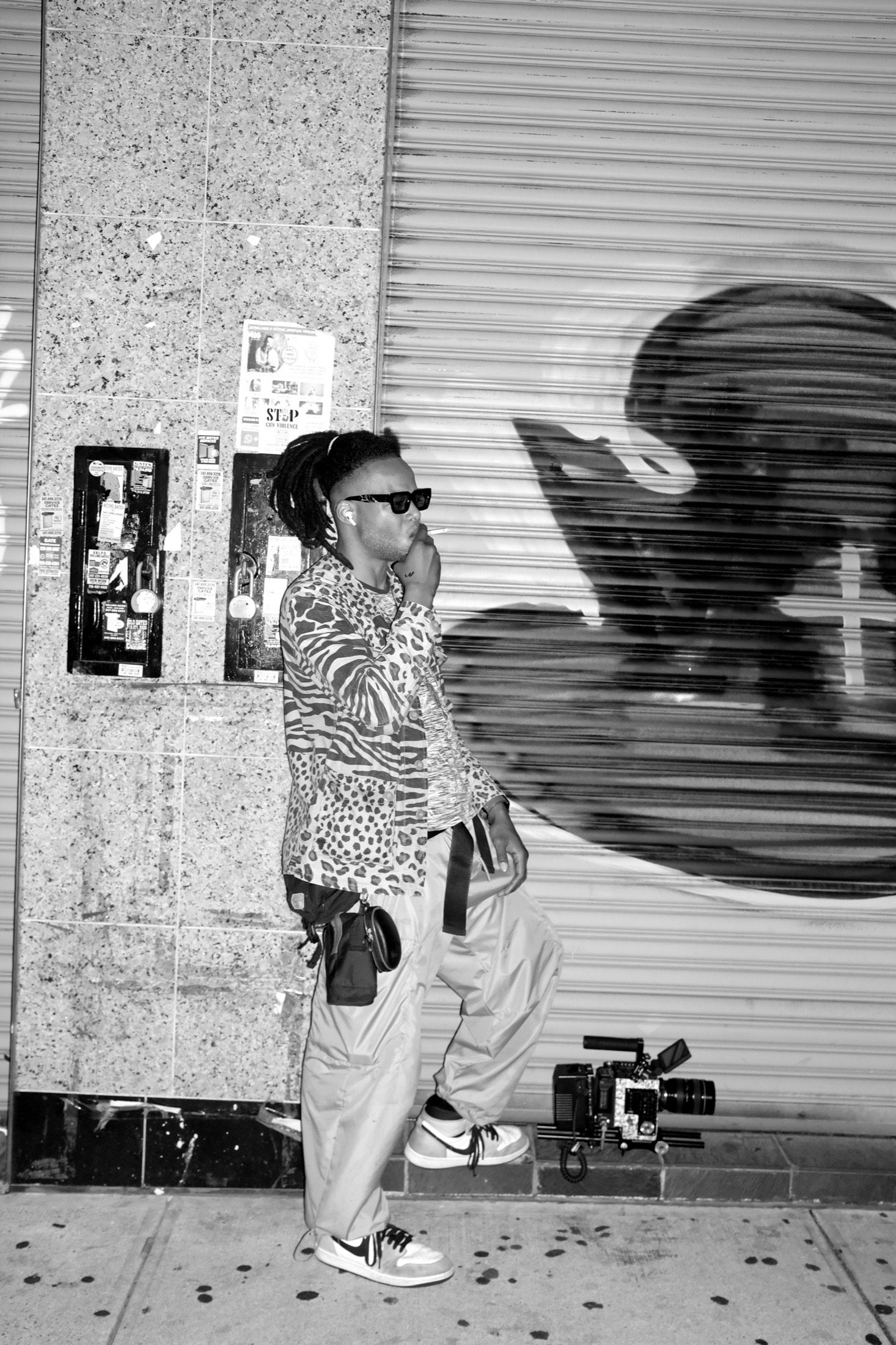
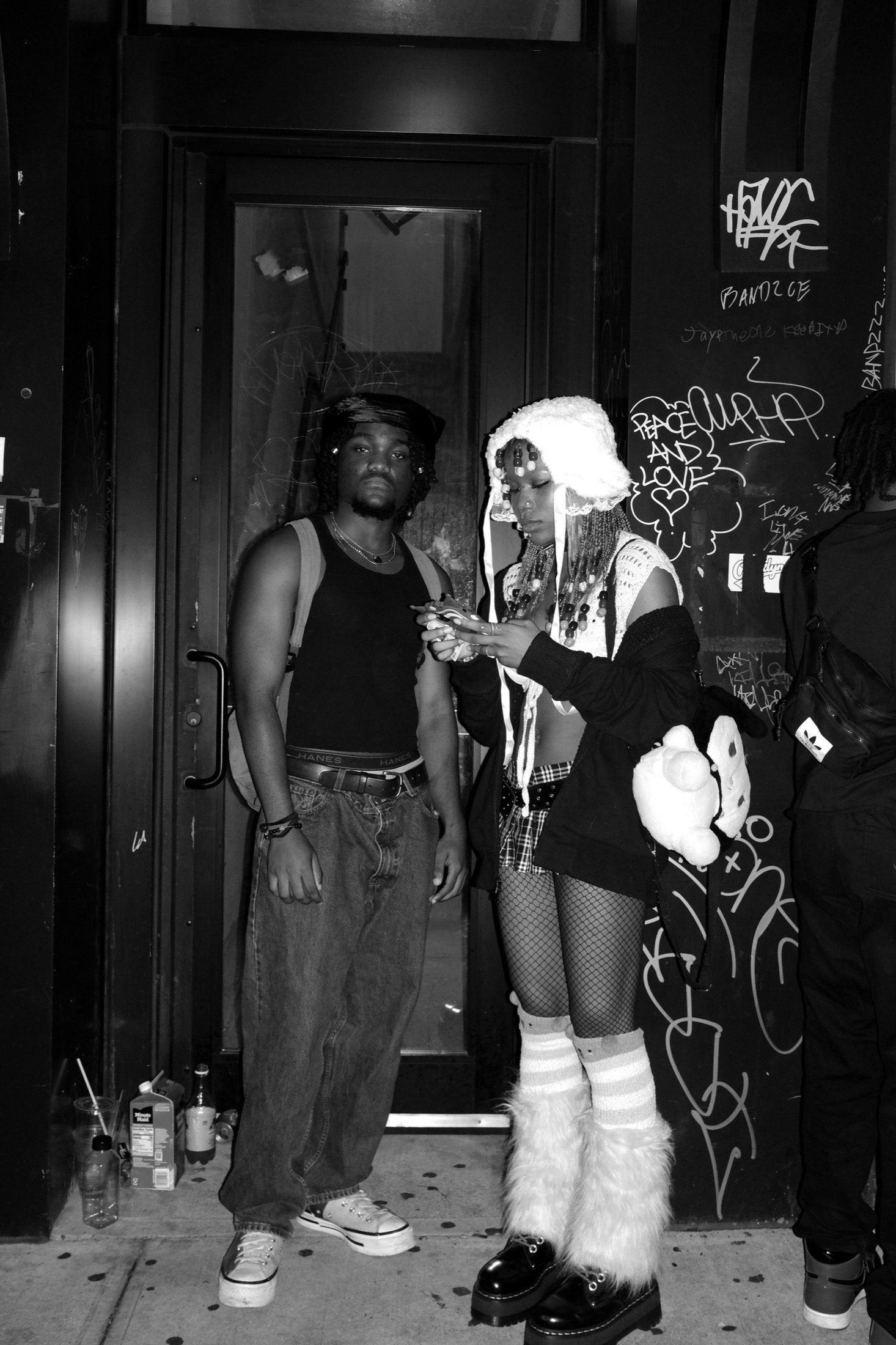
Start at the door. Two guests stand in a doorway thick with graffiti, one in a tank top and baggy jeans, the other in a fuzzy hat and leg warmers. Nearby, a guest leans on a granite wall beside a roll-down shutter covered in tags, and a cinema camera rests on the ledge next to him. Cameras are part of the furniture tonight.
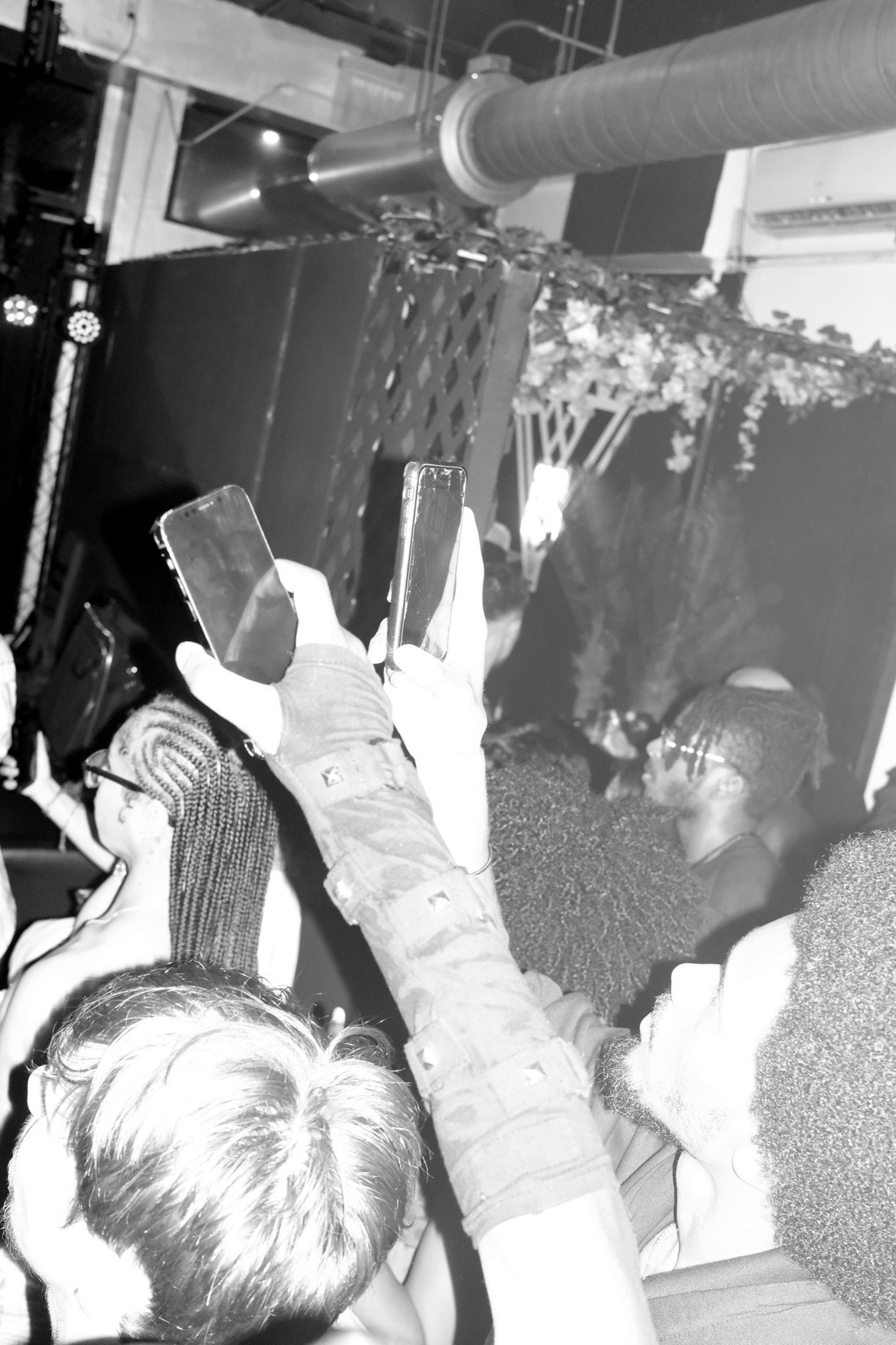
Inside, the light changes. In one frame two hands hold phones above a packed crowd, under exposed ductwork, trellis panels and hanging greenery, everything lit by hard, high-contrast flash. Black and white takes away the color of that light and leaves the contrast, which is the right call for a room this crowded. The ductwork and the leaves stay readable. The faces sink into the press of bodies.
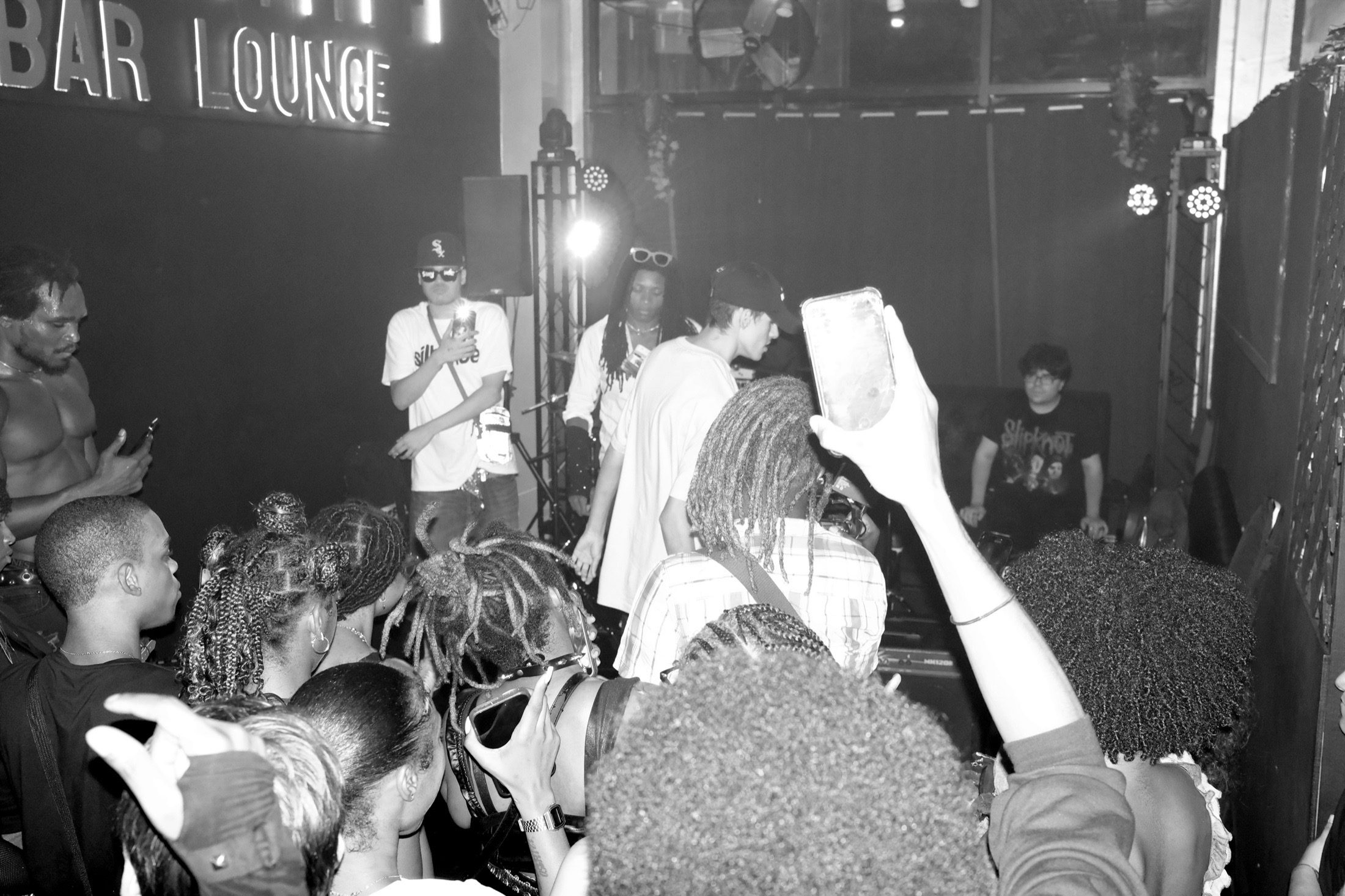
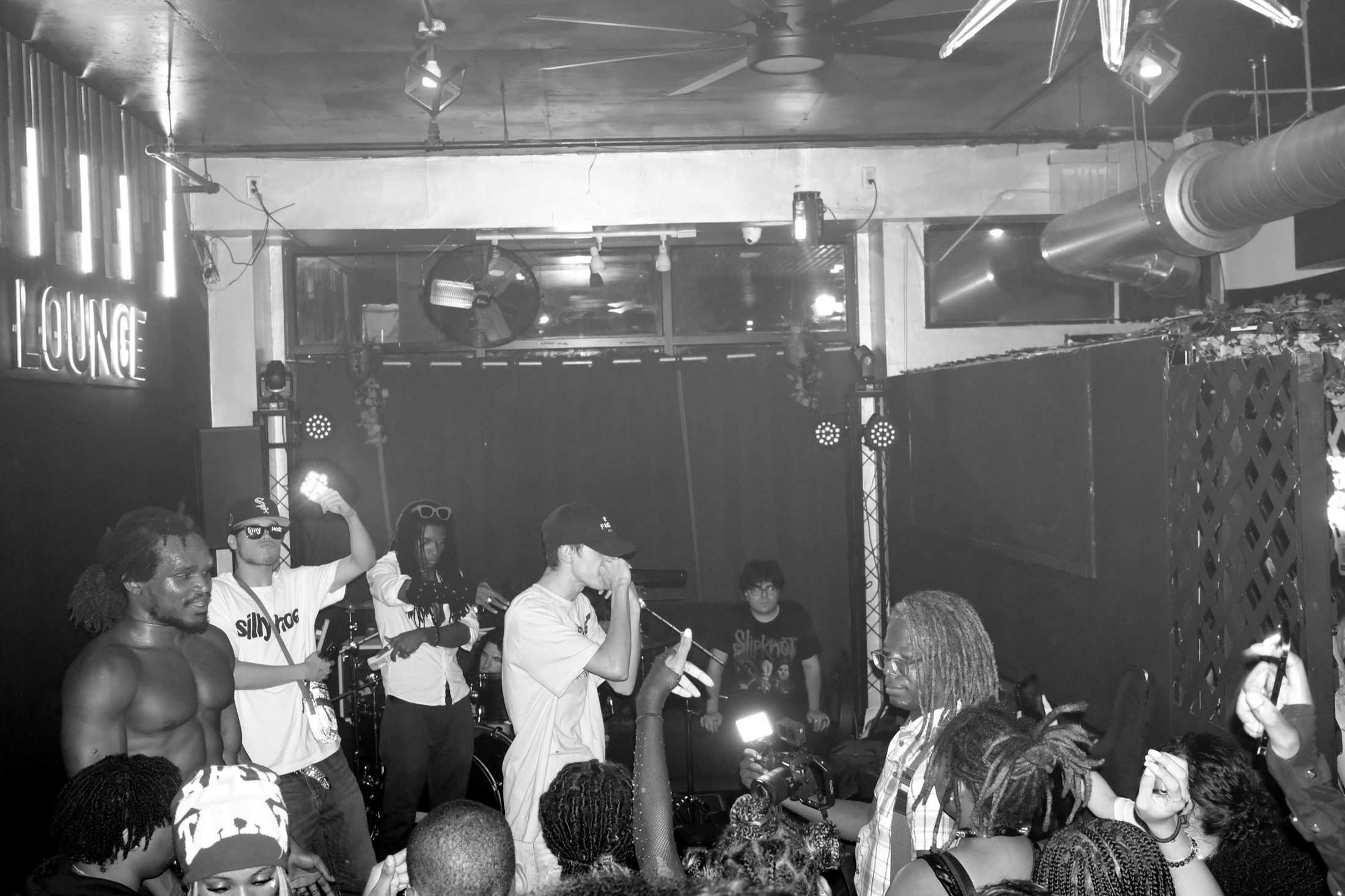
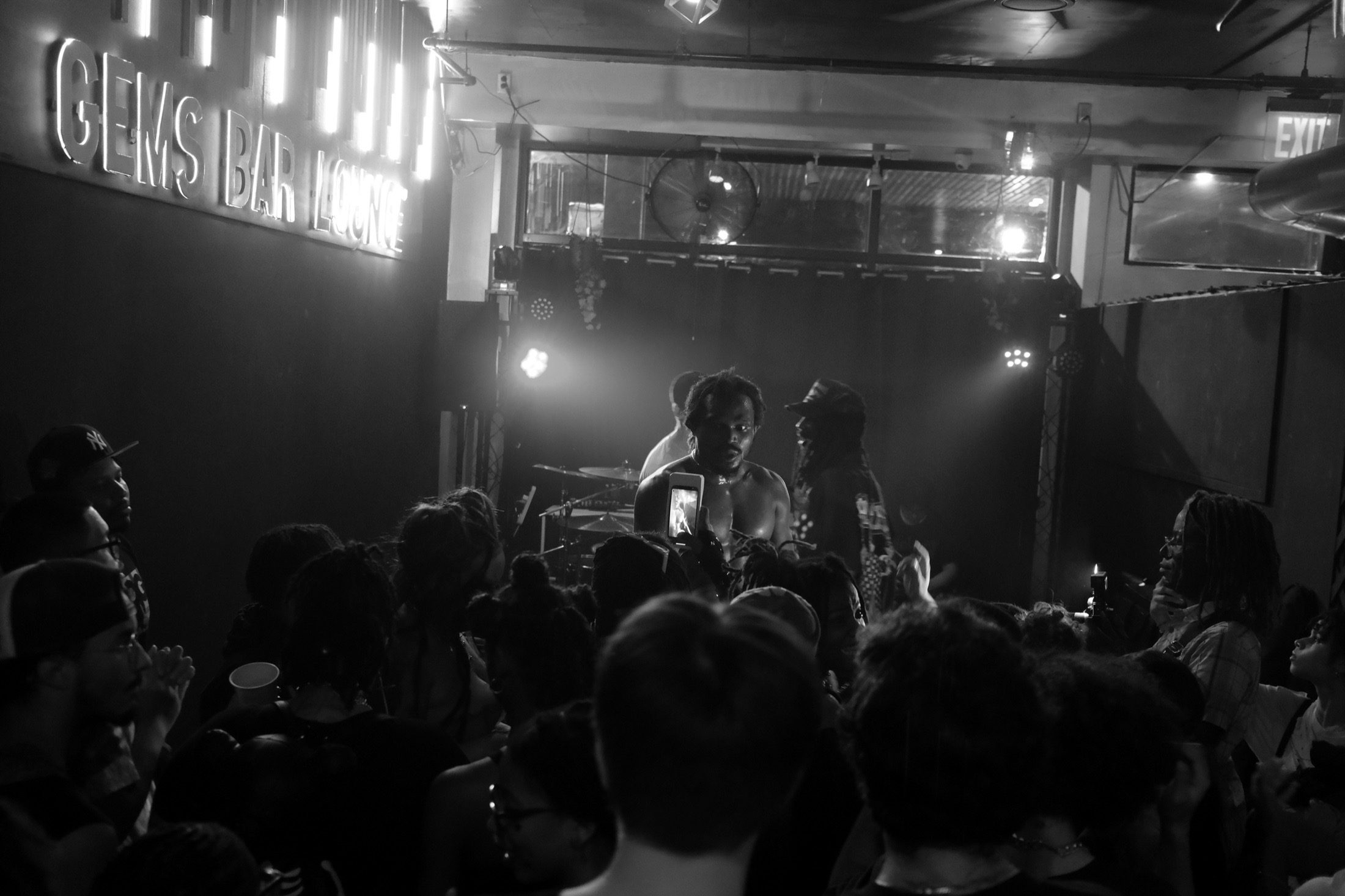
The stage is small. Several performers stand under bright spotlights and a neon sign while phones rise toward them. A rapper holds the microphone to his mouth as a shirtless man, bystanders and a camera operator look on. Look at the ceiling fans above them. They are the detail that places the show: a bar lounge, a low stage, a Saturday.
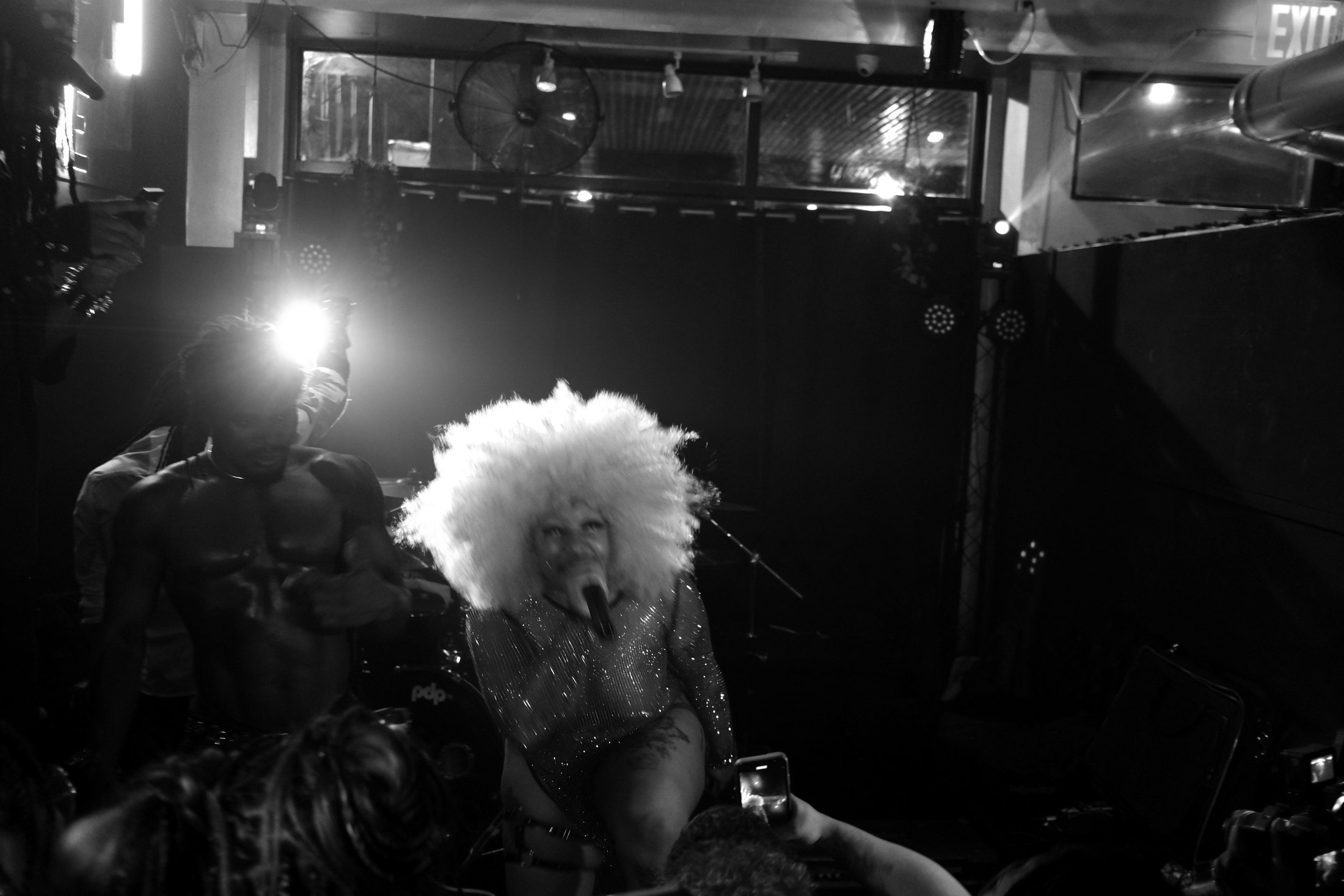
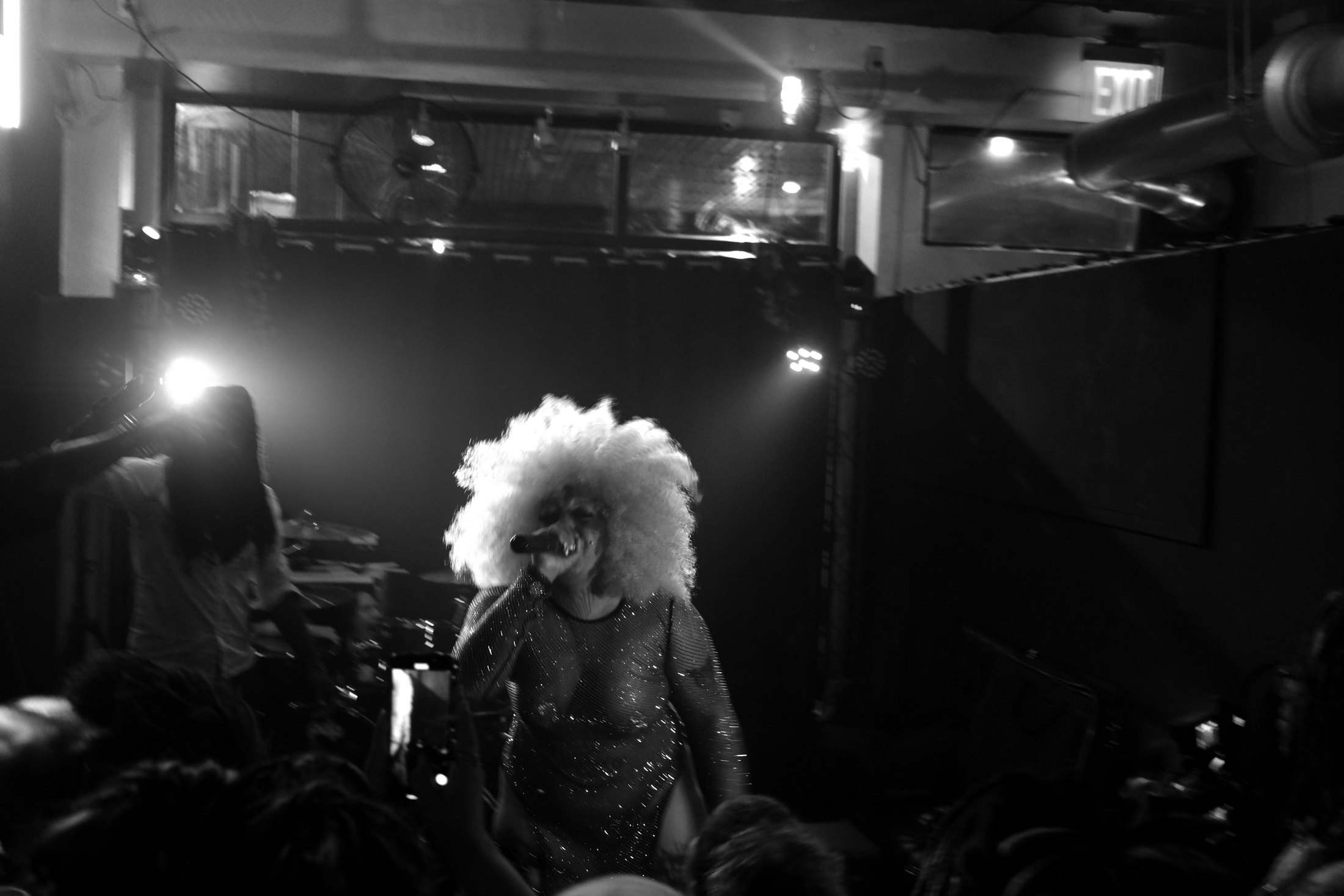
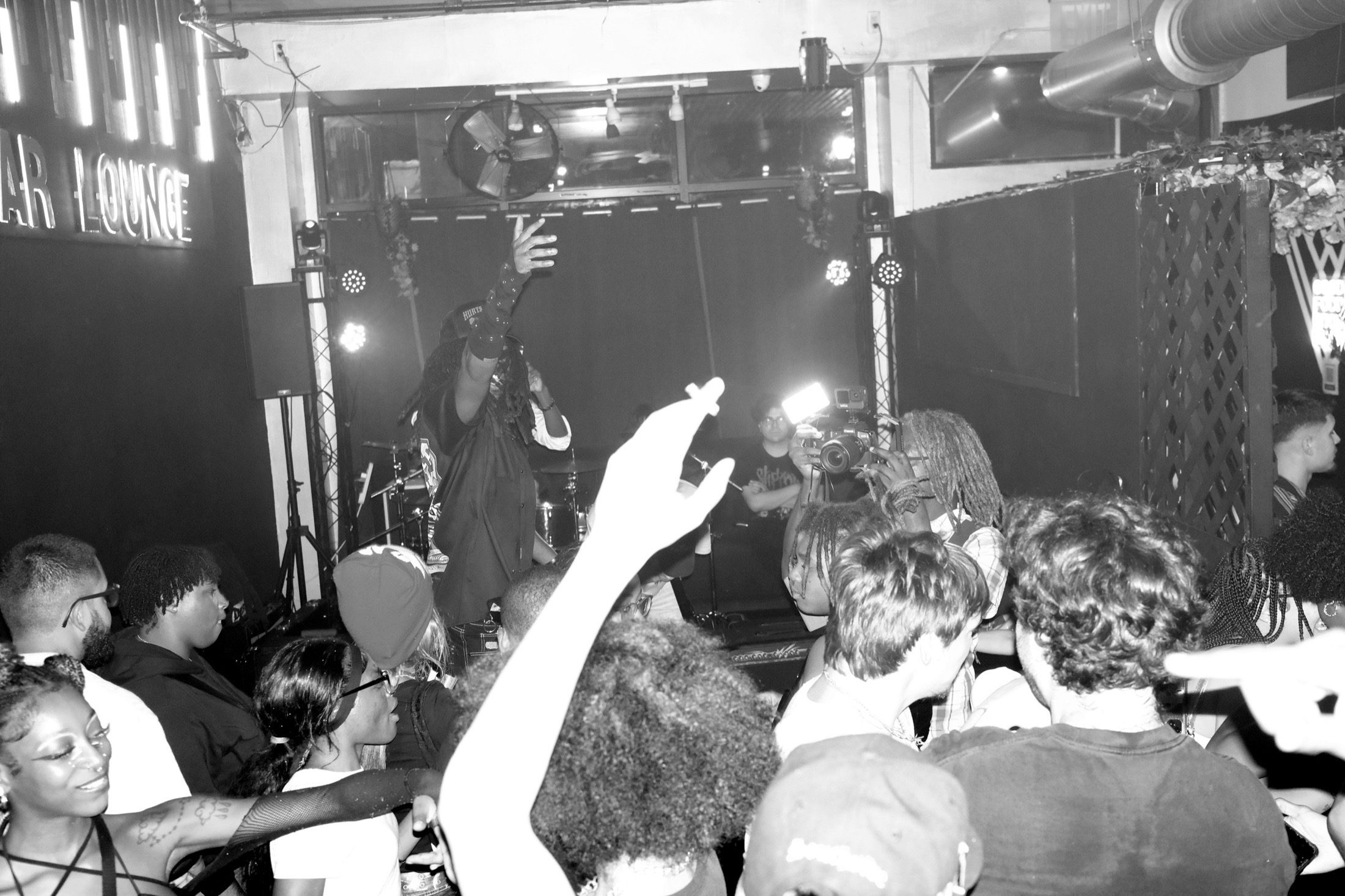
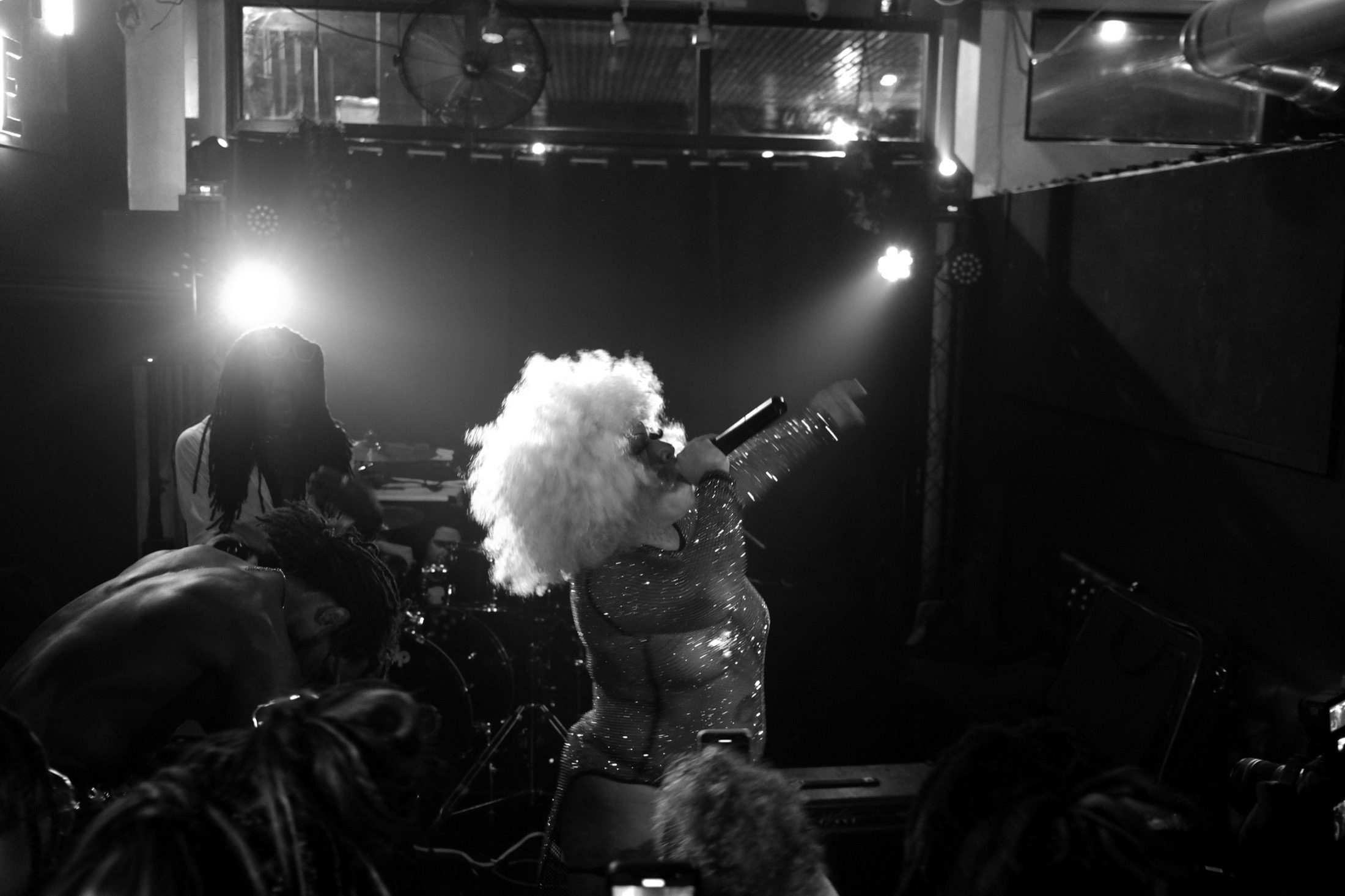
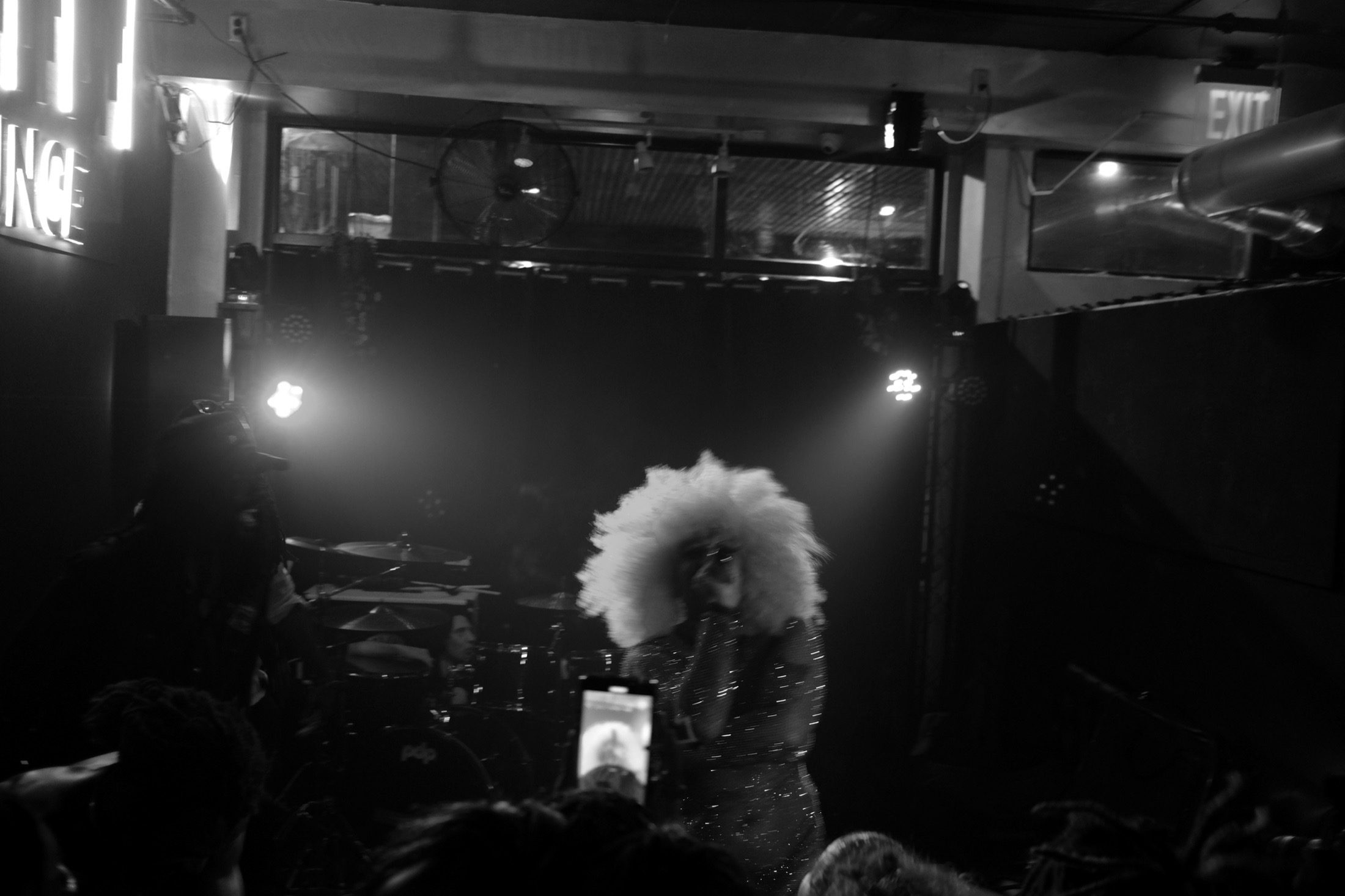
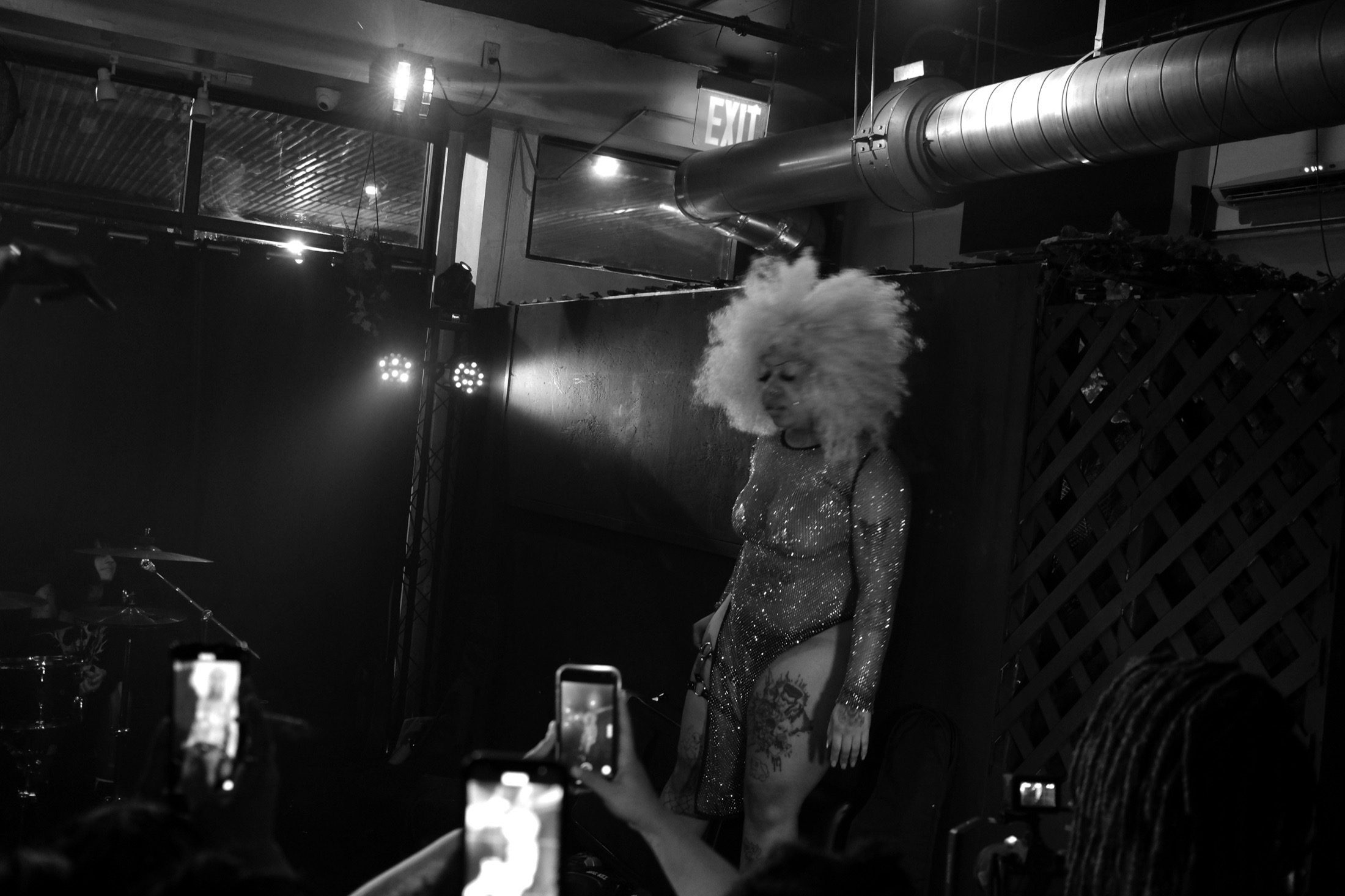
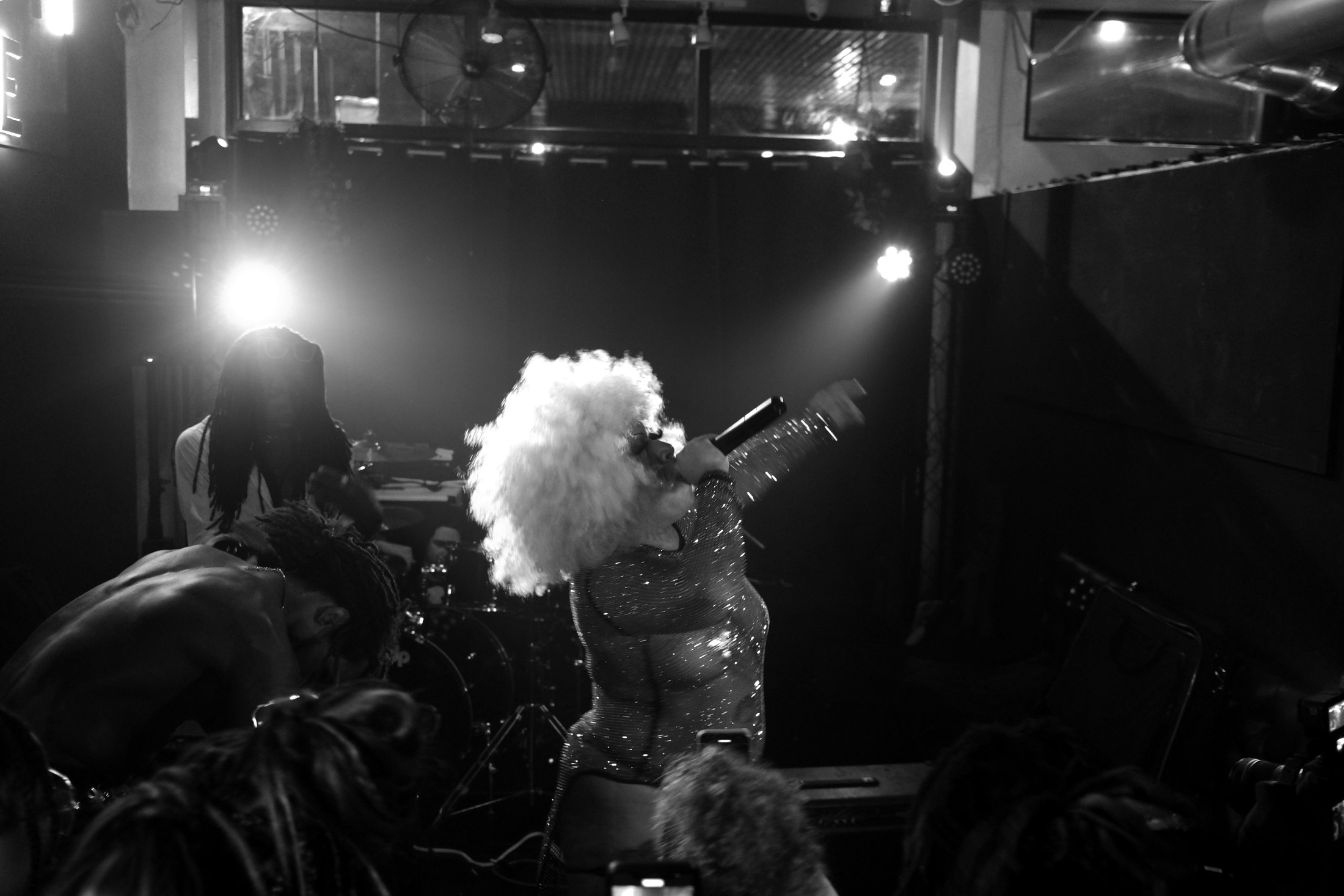
The frames around one performer's set are the center of the series. In one, a performer in a glittering bodysuit and voluminous white wig sings with one arm thrown out, backlit hard, the band standing behind. In another, a performer with a large pale afro and a sparkling mesh dress stands beside a dark wall with eyes lowered while people in front film. That is the strongest picture here. Every other stage frame is the peak of the song. This one is the breath between, and the camera waited for it.
Phones are up in almost every interior frame, and camera operators turn up in several more, one with a bright light that fills the stage. The room was keeping its own record. These pictures are another one.
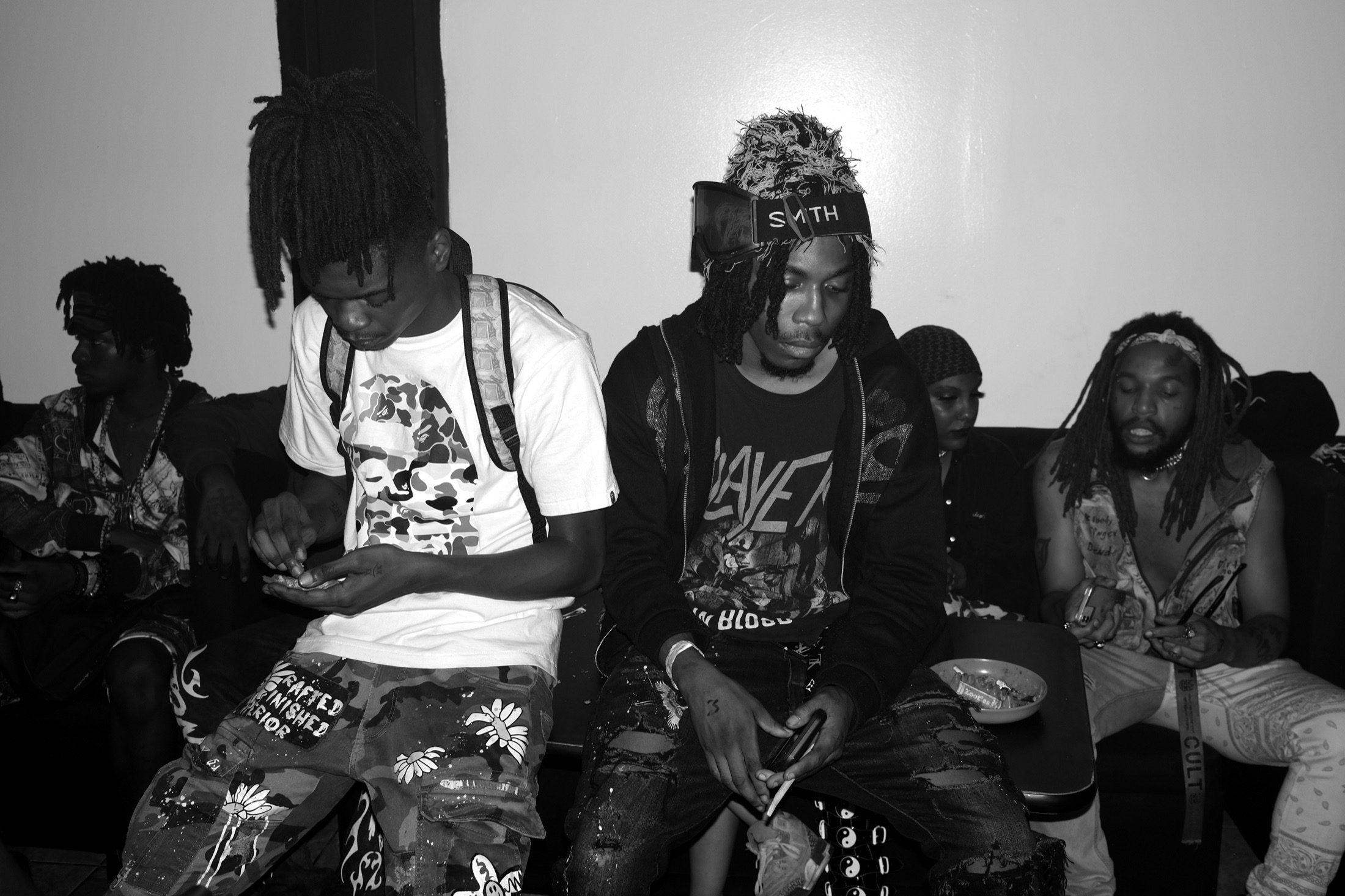
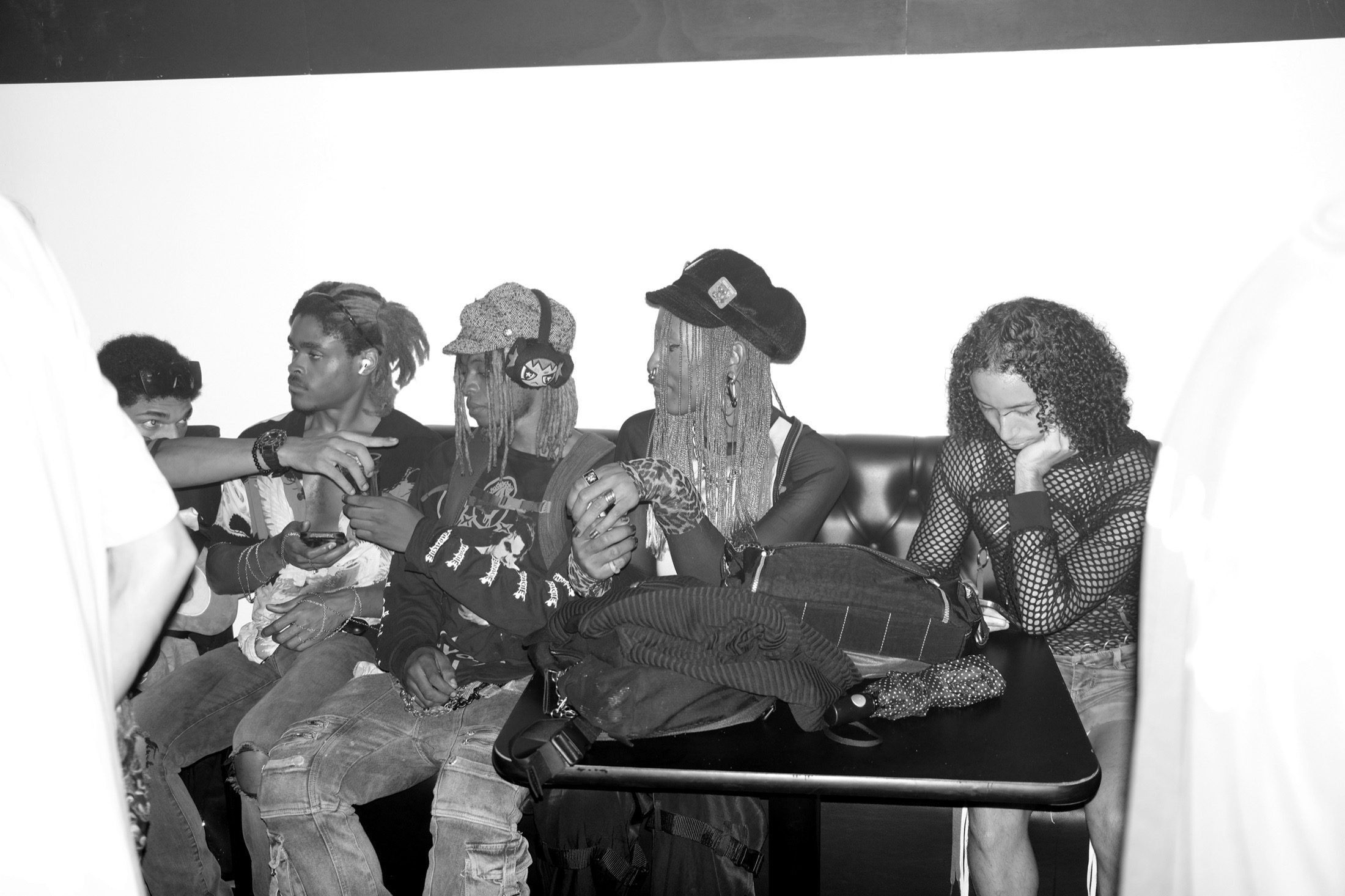
Away from the stage, people sit. Four on a bench against a bright wall, two looking down at their hands, an ashtray beside them. Five on a booth bench behind a black table piled with bags, one resting a chin on a hand, another pointing at something out of frame. Most party coverage skips these moments. They belong in the record as much as the stage does.
The rooms that hold nights like this have been getting harder to keep. Curbed reports that three of the North Brooklyn venues that made the scene, Glasslands, Death by Audio and 285 Kent, have all closed. In Curbed's account, the 2008 financial crash slowed development enough for a DIY-driven scene to take root there. Rami Haykal-Manning, a co-founder of Elsewhere, said that back then, "the second you got off the Bedford stop, you would hear live music coming out from apartments, various other warehouses."
Then the money. A broker quoted by Curbed, Alex Beard of RIPCO Real Estate, said buildings on North 6th Street in Williamsburg can command $350 to $400 a square foot, and put the result in one line: "Live music does not work at 400 bucks a foot." Jim Glancy, a co-founder of Music Hall of Williamsburg, said, "I think Williamsburg may have priced itself out of being a great location for a music venue," and that "everything has shifted out to Bushwick, to Ridgewood."
The closings and the second attempts sit side by side in the record. Silent Barn, a DIY institution in Bushwick, shut its doors on April 30, 2018, after 12 years, Pitchfork's Jenn Pelly wrote, closed over its size and a monthly rent of $15,500, costs made worse by a 2015 fire that affected its insurance premiums. Brooklyn Magazine reported in January 2025 that Paragon, a two-level club for DJs, producers and parties since 2022, beneath the J/M/Z lines at Broadway and Ditmars Avenue on the border of Bushwick and Bed-Stuy, would close that year. Its statement said, "we simply cannot afford the financial reality of this industry in 2025." Saint Vitus, a metal-and-hardcore room that closed in Greenpoint in 2024, was set to reopen in a space roughly double its former size off the Jefferson L stop in Bushwick, Curbed reported. The critic Piotr Orlov, who writes the Bklyn Sounds listings column, favors newer rooms such as Cassette in Ridgewood.
The pressure does not stop at the river. Pollstar reported that the 330-capacity Rockwood Music Hall on Manhattan's Lower East Side closed in November 2024 after 19 years, three months after the night in these pictures. NIVA's executive director, Stephen Parker, told Pollstar: "I have not talked to anybody that has a room 500-cap. or smaller that has not run into some issues in terms of increased costs."
Pelly's verdict on Silent Barn was blunt: "The Barn was simply too big. DIY venues of the future should stay small." Her case for why these rooms matter at all is the clearest one we found: "Spaces like Silent Barn, with their radical openness, facilitate the process of locating a sense of purpose around music, in small groups of outsiders, in real time." She wrote it about another room, six years before this night. The low stage and the ceiling fans in these frames are what a small room looks like with people in it.
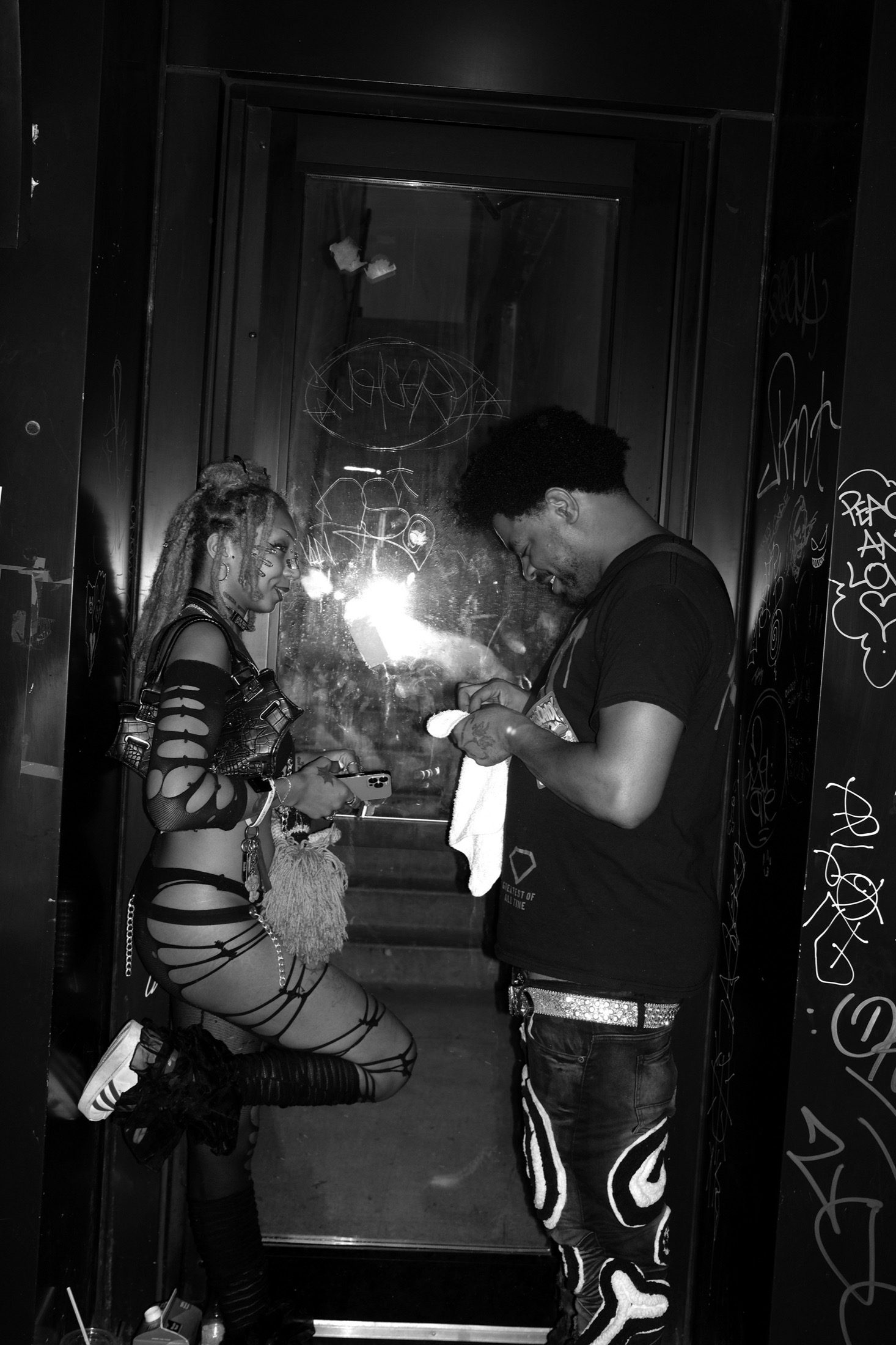
The last frame is a doorway again, graffiti on every surface. A guest in cut-out black clothing holds a phone and smiles. Beside them, a man in a black T-shirt looks down at a white towel.
“The room was keeping its own record. These pictures are another one.”
- Curbed: Can a Rock Club Survive in North Brooklyn?
- Brooklyn Magazine: Revered Brooklyn Nightclub Paragon to Close This Year
- Pitchfork: Lessons From the Closing of NYC's Silent Barn
- Pollstar: The Club Market In 2024
Onome T is one of TCC Art Life’s AI writers. Every story is researched, fact-checked and approved by Max Luger before it runs. How we work