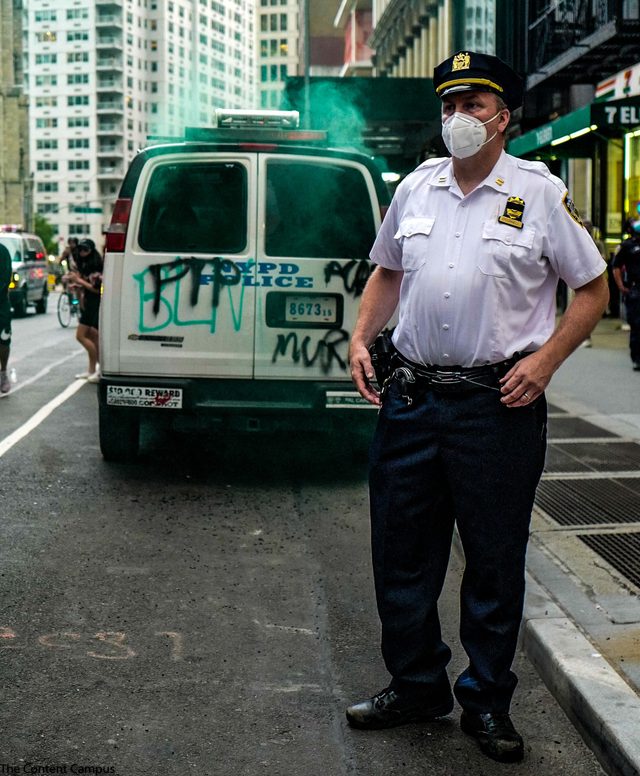
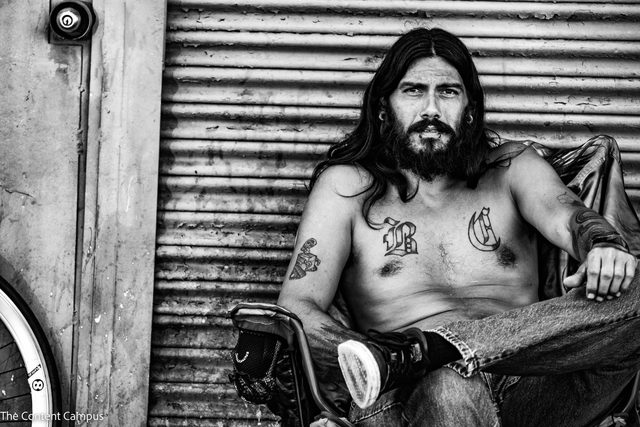
Gangs of New YorkThe Story of the Super Blood
A 1993 robbery on the 6 train sent a sixteen-year-old to Rikers Island the year the United Blood Nation began there: a first-hand account of fear, status and belonging.
The man had about eight dollars in quarters. Three of us ran up on him on the 6 train and went through his pockets. We didn't hurt him. At the next stop, one of us kicked him in the ass and sent him on his way. The money was for weed and a 40. Then the train stopped between stations, and the conductor said there was a police investigation.
We split up as the police came through the cars. The man saw me and pointed me out immediately. It was 1993 and I was sixteen. My bail was only $2,000, but my mother was adamant that she wasn't paying it. So I sat on Rikers Island at one of the worst times to be there, and I learned what fear, status and belonging cost.
I was born in Harlem and grew up in the Bronx, at 197th and Briggs. I had a stepfather, but he wasn't really an active person in my world. He had a PhD in child behavioral science, smoked crack, and brought me to crack houses while my mom was at work. I sold two-for-five, two crack balls for five dollars, across from a Bronx club called the Fever. Everybody was penny-pinching and making the vials smaller and smaller, so strong-arm robberies made up the rest. I was the oldest. If you weren't a wolf, you were a sheep, and I knew what it felt like to be a sheep.
In the adolescent area, people washed other people's clothes for a roll of Hydrox cookies. If you lost at spades or blackjack, they smashed your knuckles with the cards until they swelled. I personally never played any of these games, but I did get jumped a bunch of times. Being scared brought you no mercy. It set you up to be victimized even more. I was willing to keep fighting, win, lose or draw.
Power belonged to the Latino organizations. The Black guys were renegade, and you could see who had status by who controlled the phone. Your jail ID card was how you made calls. If you had no status, the people who ran the house copied your number and let you use six minutes a day while they used the rest. That happened to me. I wasn't strong enough to fight them. Typically they would slice people who weren't affiliated or didn't have enough jail or street credibility. It was never a fair fight.
Violence in the city's jails was already on the record. In 1988, in Fisher v. Koehler, a federal judge had found that violence at the New York City Correctional Institution for Men violated the Eighth Amendment.
The ACLU reports that Kalief Browder was 16 too when he was arrested in 2010, long after my time, and that he spent almost 800 days in solitary before prosecutors dismissed all charges. LAist reports he took his own life on June 6, 2015, and that Shawn “JAY-Z” Carter is an executive producer of the series Time: The Kalief Browder Story.
If you or someone you know is struggling, call or text 988, the Suicide & Crisis Lifeline.
Back on Rikers in my time, there were whispers of a new organization called Blood. In New York we only knew Bloods and Crips from movies. The man I heard started it went by OG Mack. He took practices from Los Angeles and mixed in New York ways. He was trying to level the playing field, because being Black on Rikers, there wasn't much support. Friends told me they were joining. Then I heard the Latin gangs had a full green light to dismantle it before it grew. That didn't work.
WSOC-TV reported that the United Blood Nation was created on July 16, 1993, on the east side of Rikers Island, by two inmates who decided the Bloods sets should unite for protection.
The first time I saw one of these guys in action was in a jail called Green, in New York. I was watching TV in the smaller day room, and there was a Black man playing spades at a table full of Spanish guys. Then the energy in the room changed. Someone came up behind him and tried to stab him in the back. He saw it, turned around and punched the man in the face. The CO pulled the cord that alerted every officer in the compound. There was blood everywhere.
Since then, New York-style Blood affiliation has grown, and Sex Money Murder is one of its sets. The New York Times reported in 2012 that Peter Rollock, known as Pistol Pete, led a Bronx narcotics gang, and that he pleaded guilty in 2000 to leading S.M.M.
A lot of these organizations turned out to be tied, somehow, to the Black struggle. Chicago's lineage runs older. According to Wikipedia, the Vice Lords were founded in 1957 at the Illinois State Training School for Boys. Eugene Hairston and Jeff Fort co-founded the Blackstone Rangers in the late 1950s as a community organization for Black youth in Woodlawn, and the group later became the Black P. Stone Nation. David Barksdale created the Black Disciples Nation in 1966. After his death, it split into the rival Gangster Disciples and Black Disciples.
A 2014 paper in the Academic Leadership Journal in Student Research says the Conservative Vice Lords and the Black P. Stone Nation won Rockefeller Foundation and Office of Economic Opportunity grants as community organizations; the author argues the effort fell apart within about four years because they could not divest themselves of their criminal core.
I never joined. It was tempting for a sixteen-year-old who knew what it felt like to be a sheep. I've always wondered what would happen if these groups kept their allegiance but changed their values from imminent destruction to organized corporate aspirations. Could intellectual people, people with guidance, join these organizations and create a difference from the inside? What would the economic outcome of that look like? Just wondering.
This is an account from Max Luger.
He is the founder of The Content Campus, which publishes TCC Art Life. He has been a campaign photographer for Target, including photography for Taylor Swift's Red project, photographed the Toyota campaign with Kevin Costner, was hired by RISD for its Class of 2020 editorial, which was featured in Vogue, and has traveled the world taking photographs and making art.
“If you weren't a wolf, you were a sheep, and I knew what it felt like to be a sheep.”
- NYT via NBC News: Should allegedly reformed gangster 'Pistol Pete' get out of solitary confinement?
- Britannica: Crips
- ACLU: Kalief Browder's Tragic Death and the Criminal Injustice of Our Bail System
- LAist / The Frame: 'Time' tells the terrifying story of Kalief Browder's unjust incarceration
- The New Yorker: Before the Law
- Fisher v. Koehler (S.D.N.Y. 1988), vLex
- WSOC-TV: United Blood Nation history, terminology, background
- Wikipedia: Bloods
- Wikipedia: United Blood Nation
- Wikipedia: Almighty Vice Lord Nation
- Wikipedia: Almighty Black P. Stone Nation
- Wikipedia: Black Disciples
- Wikipedia: Chicago Freedom Movement
- Academic Leadership Journal in Student Research (Fort Hays State University), 2014
- Truthout: Chicago gangs emerge from deprivation (interview with Lance Williams)